Qualities of a book:
1: has words. words are used to describe something or to talk about something. Can be an action an idea or anything.
2: varying in size and shapes: books are not a specific size or shape. Although a book with alot of info is normally big sometimes it is printed very small so that the book becomes pocket size.
3: value: Books vary in value. Although a well written book is generally treasured more often times a book with important ideas and concepts is discarded while a book full of garbage is kept and treasured.
4:weight: books very in weight. both in weight of the actual book and weight of the words ion the book.
5: letters. The words in a book are made of letters or symbols. it is possible to change the meaning or erase it by changing the letters.
6: images: Many books have images within the book. These images can either be to guide the story or supplemental. Some books are only made of images. Sometimes the image is distrorted or hidden.
7: purpose: the purpose of a book varies. While some books have a very specific purpose such as to teach others have no particular purpose other then to cause the reader some kind of emotion. Some books can't even do this and become paper weights.
8: binding: the binding of books vary to include anything from a piece of paper to such hard materials as metal or wood. The binding conveys a separate message and its main purpose is to both hold the book together and draw attention.
9: sound: all books have sound in turning the pages. This sound can change depending on the type of paper and its size. Some books have sound in the book that makes noises either by pushing a button or by turning the page.
10: style of print: books often contain different styles of print. These styles typically change depending on the genre or meaning within a book.
Ideas of what an be done with a book:
1: change the size of a book. Make a very small book large or a lrage book small.
2: change the shape of a book. Change the shape of a book so that it is a different shape that either works are doesnt work with the message being conveyed within the book.
3: change the words in the book. Change the words in a book just enough to change the meaning of the book or part of the book.
4: change the value of a book. Change the value of a book in some way so that what would be considered a valuable book is now less valuable and a less valuable book becomes more valuable. Example would be to paint it in gold or destroy or deface.
5: change the weight of a book. make a large book very light or a small book very heavy. Make a pocket book undesirable or a burden.
6: change the letters. Change the letters within the book so that the book is unreadable or so that each sentence is unique and does not follow the story or any word or sentence before or after. Edit our some letters to make the book harder to read.
7 : change the purpose of the book. Alter a book so that it has a specific purpose that is contrary to its original intention.
8: change the binding of the book. Alter the binding in some way so that it does not hold the book nor does it encourage people to read the book. Make it so the book is less desirable becasue of the binding.
9: changing the sound. Alter the book so that it might make strange sounds whenever touched or a page is turned.
10: change the print style. Change the print style in a way that does not work with the book. Reprint a serious book in a comedy style.
Saturday, March 29, 2008

art 108 Video: the body

The idea of beauty in the human form has changed throughout the ages. In antiquity the body was admired and painted. It was not covered but rather expressed and shown in its true form. However, as time evolved and most of the known world came under the control of the church the human form was all but hidden except in biblical images and even then the human figures would not be nude. As time progressed the church lost influence and people began expressing themselves and their art in ways that we see today. It is interesting to look at the evolution of the human figure in art and how what might have been hidden away at one time is now considered common to see. Although the church was a deciding factor in medieval art modern art seems to be more affected by fashion. It seems that most body or human art in modern times has to deal with identity, objectification, and commercialism. Although people still do make art for art's sake it is starting to become a fashion statement. No longer do tattoos have a deep meaning to the wearer but are instead a symbol or a message of coolness or power. I'm reminded of something some one once told me about society and the body. They said that every generation thinks it discovered sex. This is because every generation attempts to get a little bit riskier then the one previous. There was a time when nudity was artistic but now because it is so common it is no longer a way of self expression but a way to sell products or ideas. IN general i think the idea of the artistic nude and the beauty of the body evolved but in recent years it has just become another way to sell a product or an image.

Do Ho Suh,


Do Ho Suh is an interesting artist who has become very well know for his sculptures. Most of his work refers to the body and how it conforms to society. How people are often times asked to conform to everything around them and give up their uniqueness in order to achieve something that is supposedly greater. An example of this is his piece were he shows many school uniforms all lined up together. the Idea is that the people that would normally wear the uniforms gave up their personal identity in order to represent their school and their government. Although most of his work is not site specific it does take over the site that it is placed. An example of this would be the piece were thousands of little men are holding up a glass walkway. So although this could be placed anywhere in transforms the site its in into something unique. The medium chosen by Do Ho Suh has ranged to include everything from glass to metal. This is important because each material conveys a different message and idea. His use of metal in his piece "some/ one" is not only becasue he is using dog tags but represents the strength of the soilders that wear the tags. What is so unique about Do Ho Suh is the way he asks the viewer what role they play in society. Instead of asking in a obvious way he creates a piece that represent conformity and through it asks the viewer what roles do they conform to in their lives.
Friday, March 28, 2008
Magdalena Abakanowicz
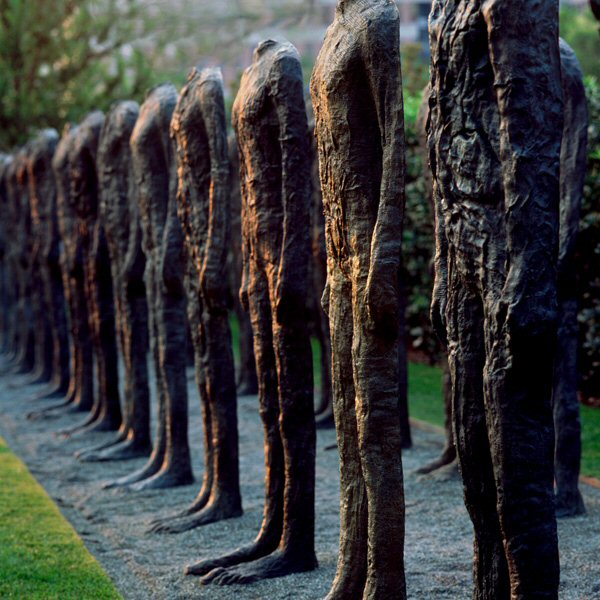

Magdalena Abakanowicz is another famous sculpture who has influenced modern art significantly. Polish born, for the first half of her life she was stuck under communist rule and ass such much of her beginning work dealt with the socialist movement. Later on in life, when she was allowed to visit the west and see western art, she began making more geometric and structured pieces. In more recent years she started using metal for her sculptures. Most of her pieces have to do with the idea of twisting. In many of her projects one can see pieces of metal or other material used and twisted to form her sculptures. It is strange to see her work becasue alot of her newer pieces uses the human form but does it in a way that would remind someone of a military sci-fi book like "1984". The are coarse and rugged but are standing in such a way that makes them seem assertive and forceful. This is most likely due to the influence the soviet union had on her in her younger days.
Anthony Gormley


Continuing on with a look at artists who specialize in 3-d sculptures I ran across Anthony Gormley. Anthony Gormley is an Englishmen who has become very well know for his sculptures that represent the human image. Most of his pieces are created from body molds of himself which he then alters or enlarges to his needs. Although he does have alot of smaller life size work some of his best know pieces are giant sculptures that overlook places like beaches or cities. His largest piece " angel of the north" is 20m high by 54m wide and is Britains largest sculpture. In talking about his work he says it is not suppose to be symbolic of something but representational of a time or action. Its almost like making a three dimensional picture. What makes much of Gromleys work so great is and popular is that he is using the human image to convey a message and doing it in a public way for all to see.
Thursday, March 20, 2008

Thursday, March 13, 2008
Art 108 Journal/Sketchbook assignment Design Terms
Emphasis: An object or style that is of special importance. A focus on one particular object or style over all others.


The emphasis of George Segal’s sculptures is the human form but presented in a sort of ghostly way.
Illusion of motion: A deceptive or misleading image or object that appears to the viewer as if it is in motion or in some action while in reality the image or object is standing still. This is a result of an image or object being created mid action and therefore the viewer wants to complete the action in their mind.


Water droplets and splashes are a good example of the illusion of motion because we have seen water splash before and our mind desires to see the end of the splash but we are unable to.
Abstract: Images or objects that is non-representational. These images or objects generally have no correlation to the real world and often are an attempt to depict intangible things such as emotions. Although they might remind the viewer of something they are in no way a depiction or a representation of it.
This image is abstract because it is non representational and most likely expresses some emotion or thought that is indescribable.
Variety: A way of combining artistic elements to create complex relationships. It is achieved by combining diverse artistic elements in order to increase the visual appeal.

This piece of art contains a wide variety of different artistic elements such as hue, tint, context, hidden meaning, etc.
Volume: The amount of space found or seen within a form.

Because of the way this is painted and where it was hung in the church it made it seem as if the church had a greater volume then it actually did.
Monochromatic: A piece consisting of a single color or hue but may includes different tints or shades of the hue.
This images is monochromatic because the entire image is the same hue.
Warm/ Cool Color: warm colors are colors such as red orange and yellow which are associated with heat. Cool colors include greens blues and violets which are generally associated with cold.


The first image contains warm colors while the second contains cool colors.
Negative: A tonal inverse of a positive image. All colors, tints, and shades are reversed from their original so white would normally be light is now dark and what would be red now appears cyan. This is typically seen in photography when a light sensitive materials are subjected to photosensitive chemicals.
This is a negative image. When it is used to make prints all the light areas will become dark and all the dark areas will become light.
Works Cited
http://www.artincanada.com/arttalk/arttermsanddefinitions.html#m
http://www.artlex.com
Kleiner, Fred. Mamiya, Christin. Gardner’s Art Through The Ages The Western Perspective. Volume 2 Twelfth Edition. Thomson Wadsorth, 2006.
http://wikipedia.org


The emphasis of George Segal’s sculptures is the human form but presented in a sort of ghostly way.
Illusion of motion: A deceptive or misleading image or object that appears to the viewer as if it is in motion or in some action while in reality the image or object is standing still. This is a result of an image or object being created mid action and therefore the viewer wants to complete the action in their mind.


Water droplets and splashes are a good example of the illusion of motion because we have seen water splash before and our mind desires to see the end of the splash but we are unable to.
Abstract: Images or objects that is non-representational. These images or objects generally have no correlation to the real world and often are an attempt to depict intangible things such as emotions. Although they might remind the viewer of something they are in no way a depiction or a representation of it.

This image is abstract because it is non representational and most likely expresses some emotion or thought that is indescribable.
Variety: A way of combining artistic elements to create complex relationships. It is achieved by combining diverse artistic elements in order to increase the visual appeal.

This piece of art contains a wide variety of different artistic elements such as hue, tint, context, hidden meaning, etc.
Volume: The amount of space found or seen within a form.

Because of the way this is painted and where it was hung in the church it made it seem as if the church had a greater volume then it actually did.
Monochromatic: A piece consisting of a single color or hue but may includes different tints or shades of the hue.

This images is monochromatic because the entire image is the same hue.
Warm/ Cool Color: warm colors are colors such as red orange and yellow which are associated with heat. Cool colors include greens blues and violets which are generally associated with cold.

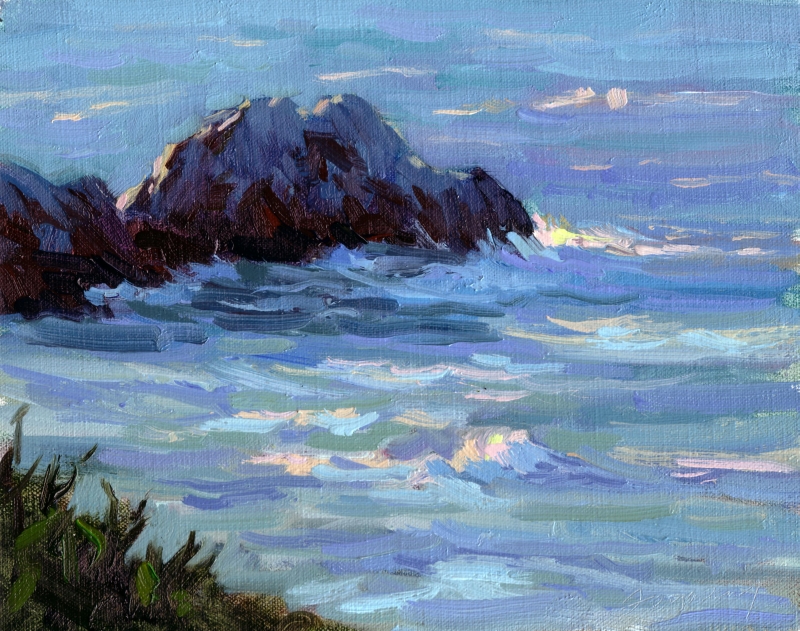
The first image contains warm colors while the second contains cool colors.
Negative: A tonal inverse of a positive image. All colors, tints, and shades are reversed from their original so white would normally be light is now dark and what would be red now appears cyan. This is typically seen in photography when a light sensitive materials are subjected to photosensitive chemicals.
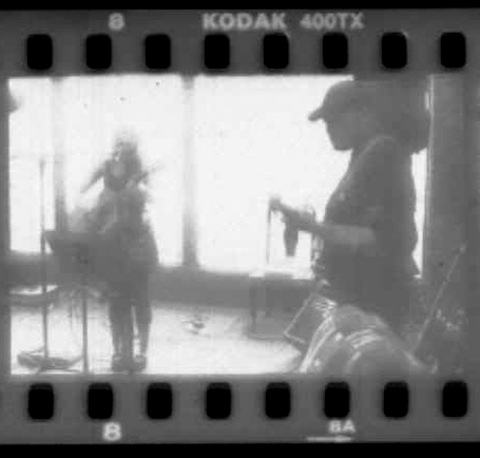
This is a negative image. When it is used to make prints all the light areas will become dark and all the dark areas will become light.
Works Cited
http://www.artincanada.com/arttalk/arttermsanddefinitions.html#m
http://www.artlex.com
Kleiner, Fred. Mamiya, Christin. Gardner’s Art Through The Ages The Western Perspective. Volume 2 Twelfth Edition. Thomson Wadsorth, 2006.
http://wikipedia.org
Subscribe to:
Posts (Atom)